Accounting & Bookkeeping
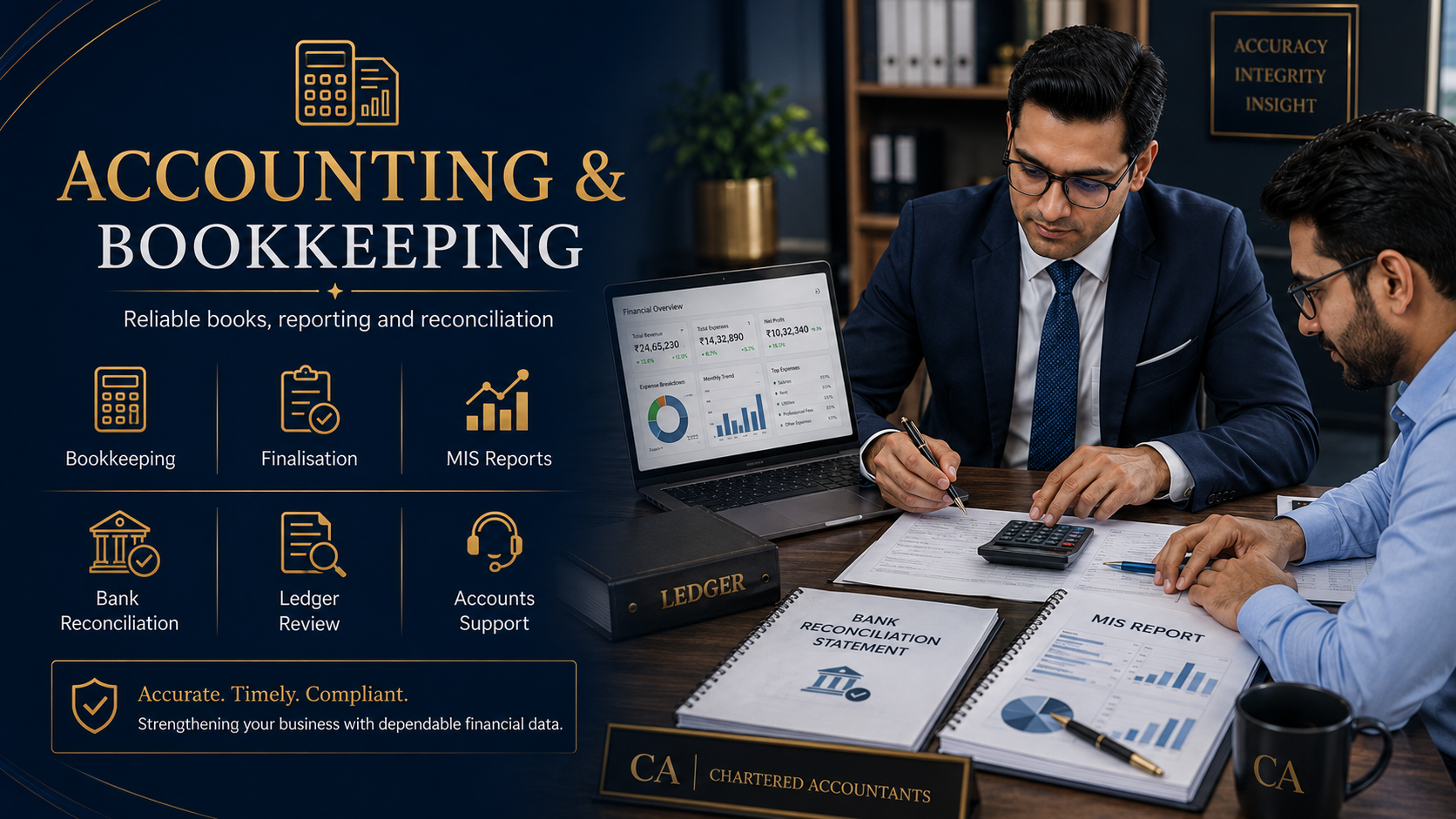
Professional bookkeeping, backlog accounts clean-up, account finalisation, MIS reporting, inventory accounting and statutory reconciliation support — helping businesses maintain clean, GST-compliant, tax-ready and audit-ready financial records throughout the year.
Overview
Accurate and updated accounting records are the foundation of correct GST return filing, income-tax compliance, informed management decisions, statutory audit and bank reporting. Irregular bookkeeping — entries made in bulk at year-end, incorrect classification of expenses, incomplete reconciliations or unsupported ledger balances — may result in wrong returns, avoidable tax exposure, audit queries and weak financial control.
Varun Amita Gupta & Co. provides systematic bookkeeping, backlog accounting clean-up, account finalisation, MIS reporting, bank reconciliation, GST reconciliation, inventory and stock accounting support, payroll support, fixed asset records and year-end closing. We work with Tally Prime, Busy, QuickBooks and other accounting software, adapting to the client's existing system and data format. Wherever tax computations are involved, we align records with the Income-tax Act, 1961 and the Income-tax Act, 2025, as applicable.
Services Covered
Monthly Bookkeeping
Regular recording of sales, purchases, expenses, receipts, payments and journal vouchers with proper ledger classification.
Backlog Accounting & Books Clean-Up
Completion and correction of pending or improperly maintained books for previous months or years.
Account Finalisation
Preparation of trial balance, trading account, profit and loss account, balance sheet and supporting schedules.
MIS Reporting
Monthly and quarterly management reports covering revenue, expenses, margins, cash position and key business indicators.
Ledger Scrutiny
Review of all ledger accounts to identify errors, duplicate entries, incorrect postings and unusual items.
Bank Reconciliation (BRS)
Monthly reconciliation of bank statements with the cash and bank ledger in books.
GST Reconciliation
Reconciliation of turnover and ITC in books with GSTR-1, GSTR-3B and GSTR-2B returns.
Accounts Payable & Receivable
Party-wise tracking of outstanding balances with ageing analysis.
Inventory / Stock Accounting
Stock register review, inventory valuation support and reconciliation of stock records with books.
Year-End Closing
Year-end adjustments, provisions, depreciation and compilation of audit-ready records with supporting schedules.
Payroll Processing
Monthly salary computation, PF/ESI, salary TDS, payslips, payroll entries and statutory challan support.
Fixed Asset Register
Maintenance of fixed asset register with depreciation workings under the Income-tax Act, 1961 / Income-tax Act, 2025 and Companies Act, 2013.
Detailed Scope of Work
Monthly Bookkeeping & Voucher Entry
We record sales invoices, purchase invoices, expense vouchers, bank receipts and payments, journal entries and adjustment entries systematically each month. Entries are classified under appropriate ledger heads with due consideration of GST, TDS and income-tax treatment under the Income-tax Act, 1961 / Income-tax Act, 2025, as applicable. Purchase invoices are checked for GSTIN, GST rate, invoice details and basic ITC eligibility before entry, which simplifies monthly reconciliation. Regular bookkeeping keeps the books ready for GST return filing, TDS computation, management review and audit, without the errors that generally arise from rushed year-end data entry.
Backlog Accounting & Books Clean-Up
Many businesses face situations where accounts are pending for several months or years, entries have been passed without proper narration, ledgers are wrongly grouped, GST and TDS entries are inconsistent, or books maintained by the previous accountant require correction. We review the available data, bank statements, invoices, GST returns, TDS records and ledger balances to rebuild or clean up the books in a structured manner.
Our clean-up process includes identification of duplicate or missing entries, correction of wrong ledger classification, reconciliation of opening balances, vendor and customer ledger clean-up, bank reconciliation, GST and TDS reconciliation, and preparation of corrected trial balance. This helps clients convert incomplete or unreliable accounts into usable financial records for audit, tax filing, bank reporting and management review.
Account Finalisation — P&L and Balance Sheet
We prepare complete financial statements after reviewing ledger balances, passing necessary year-end entries for depreciation, outstanding expenses, prepaid expenses, provisions, bad debts, GST reconciliation differences and other closing adjustments. Financial statements are prepared in a format suitable for statutory audit, tax audit, income-tax return filing, bank submissions and management review. Supporting schedules for fixed assets, debtors, creditors, loans, advances, investments and statutory dues are maintained so that the financial statements are not merely prepared, but properly supported.
MIS Reporting — Monthly & Quarterly
We prepare customised MIS reports covering revenue analysis by product, segment or branch, expense summary with comparison to prior periods, gross margin, EBITDA, cash and bank position, debtor and creditor ageing and key business ratios. Reports are designed to be concise, practical and decision-oriented, so that owners and management can understand business performance without spending time on raw accounting data. For group entities, branch-wise and consolidated MIS reports can also be prepared.
Ledger Scrutiny & Account Reconciliation
We scrutinise individual ledger accounts including debtors, creditors, loans and advances, expenses, income accounts and statutory ledgers to identify duplicate entries, missed entries, wrong ledger classification, unexplained balances and unusual items. Control account reconciliation and party-wise reconciliation are carried out wherever required. Inter-company balances for group entities are also reviewed and matched. Differences identified during scrutiny are documented and corrected through proper journal entries with management approval.
Bank Reconciliation Statement (BRS)
We prepare bank reconciliation statements by comparing bank statement balances with book balances for each bank account. Uncleared cheques, deposits in transit, bank charges, interest credits, failed transactions and other timing differences are identified and listed. Direct debits and credits not recorded in the books are passed through proper entries. Regular BRS helps detect unauthorised or missed transactions, keeps bank balances accurate and makes audit and compliance review smoother.
GST Reconciliation — Books vs Returns
We reconcile turnover and output GST as per books with GSTR-1 and GSTR-3B, and reconcile input tax credit as per books with GSTR-2B. Differences are identified and documented, including timing differences, supplier non-filing, credit notes, wrong GSTIN, invoice mismatch or return filing errors. Monthly GST reconciliation helps reduce future notices, protects eligible ITC, supports GSTR-9 preparation and keeps records ready for audit or departmental verification.
Accounts Payable & Receivable Management
We maintain party-wise ledgers for debtors and creditors, generate ageing reports and highlight overdue balances requiring follow-up. Vendor payments are reviewed for applicable TDS under the Income-tax Act, 1961 and the Income-tax Act, 2025, as applicable. Advances, credit notes, part-payments and invoice-wise outstanding balances are reconciled with the books. For high-volume businesses, weekly or fortnightly collection and payment statements can also be prepared to improve cash-flow control.
Inventory / Stock Accounting & Valuation Support
For trading and manufacturing businesses, correct stock accounting has a direct impact on profit, GST reporting, audit observations and income-tax computation. We assist in maintaining item-wise stock records, purchase and sales quantity reconciliation, opening and closing stock verification, inventory movement review and reconciliation of stock records with books of accounts.
We also support inventory valuation at period-end by reviewing quantity records, cost data, purchase rates, closing stock workings and related accounting entries. Proper stock accounting helps identify shortages, excess stock, slow-moving items, valuation differences and documentation gaps before they become audit or tax issues.
Year-End Closing & Audit-Ready Records
Year-end closing includes depreciation entries under section 32 of the Income-tax Act, 1961 / section 33 of the Income-tax Act, 2025, as applicable, and depreciation as per Schedule II of the Companies Act, 2013, wherever relevant. We also review accruals, prepaid expenses, provision for doubtful debts, provision for tax, inventory valuation, closing stock, partner remuneration, director remuneration and statutory dues. A complete audit file is compiled with trial balance, supporting schedules, bank reconciliation statements, TDS summary, GST reconciliation and fixed asset register, making the statutory audit process more efficient and organised.
Payroll Processing & PF/ESI
We process monthly payroll covering gross salary, applicable statutory deductions, employee PF, ESI wherever applicable, professional tax and other agreed deductions. Salary TDS is computed under section 192 of the Income-tax Act, 1961 / section 392 of the Income-tax Act, 2025, as applicable, based on projected annual salary and employee declarations. Net pay calculations and payslips are generated, PF/ESI challan support is provided and payroll entries are posted in the accounting software. Annual salary certificate support is also provided through Form 16 / Form 130, as applicable under the relevant tax framework.
Fixed Asset Register & Depreciation
We maintain a fixed asset register covering asset description, date of purchase, cost, useful life, depreciation rate, accumulated depreciation and written-down value for each asset. Depreciation is computed under section 32 of the Income-tax Act, 1961 / section 33 of the Income-tax Act, 2025, as applicable, for tax purposes, and separately under Schedule II of the Companies Act, 2013 for financial reporting. Additions, disposals, put-to-use dates and half-year depreciation implications are recorded correctly so that fixed asset records remain audit-ready and tax-ready.
Require Assistance with Accounting & Bookkeeping?
Contact CA Varun Gupta for a professional discussion on your specific requirement. All enquiries are treated with strict confidentiality.